
The best recipes for Christmas pastries in the Czech Republic and Slovakia
Don't know what Christmas cookies to bake this year? Our editorial team has selected 10 of the best and most proven recipes that anyone can manage – from classic Walnut Tartlets (Ořechové košíčky) to delicate Hunter's Buttons (Myslivecké knoflíky) or fragrant Gingerbread/Gingersnaps (Zázvorníky).
And what's best? You can easily prepare all these cookies with the help of kitchen assistants from ORAVA, which will save you time and effort and ensure perfectly smooth doughs, creams, and egg whites.

How to make preparing Christmas cookies easier?
Christmas baking can be a wonderful tradition, but also quite a lot of hard work – especially when dealing with dense doughs, stiff egg whites, or large quantities of cookies at once. If you want the work to go faster, more precisely, and without unnecessary effort, it pays to have a reliable assistant on hand.
That's why the ORAVA Chef 3 kitchen robot is a great choice; it can handle even demanding Christmas doughs and will save you a lot of time.
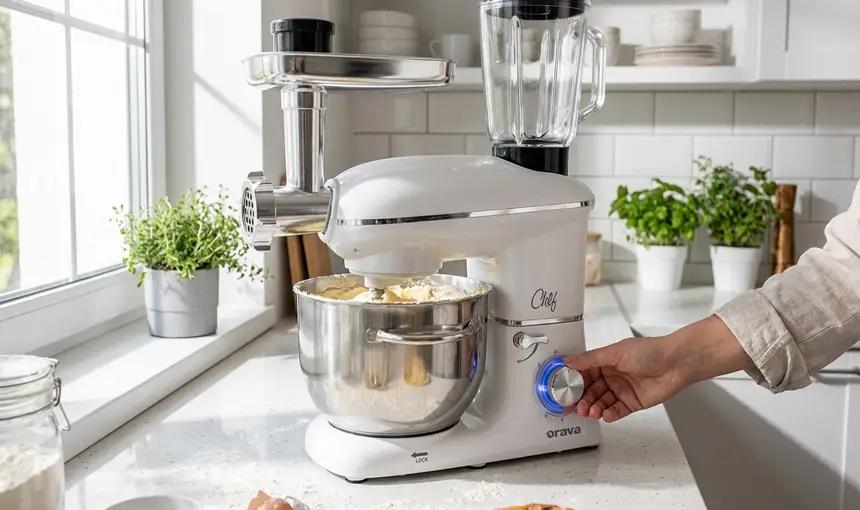
Power that no dough can stop
The robot has a power input of 2000 W, so it can handle everything – from stiff butter mixtures to yeast doughs to thick creams or nut mixtures. Thanks to the powerful motor, you don't have to worry about long whisking or mixing; the robot doesn't overheat and maintains constant power throughout.
Accessories that cover all Christmas baking needs
In the package, you will find everything that is truly used in baking:
• Dough hook – for yeast dough, gingerbread, and dense mixtures
• Whisk attachment – for egg whites, butter creams, glazes
• Mixing (K) paddle – for shortcrust and butter dough
• Large stainless steel bowl – stable, voluminous, easy to maintain
• Splash guard – less mess, more joy
You can use the ORAVA Chef 3 not only during Christmas but all year round – for pies, pizza, homemade bread, pancakes, cake creams, and savory dishes.
10 of Orava's best Christmas cookie recipes

Walnut Tartlets Recipe (Czech Republic)
How to prepare the dough (10 minutes + 20 minutes chilling)
Ingredients:
• 200 g plain flour
• 100 g powdered sugar
• 120 g softened butter
• 1 egg yolk
• Pinch of salt
Instructions: Mix all ingredients and knead a smooth dough (approx. 5–10 min). Chill for 20 minutes. Lightly grease the tartlet molds and press the dough evenly into them. Prick the bottom with a fork.
How to prepare the cream (5 minutes)
Ingredients:
• 150 g butter
• 120 g powdered sugar
• 2 tablespoons rum
• 70 g ground walnuts
• 1 vanilla sugar
Instructions: Whisk the butter with the sugar (2 min). Add rum, walnuts, and vanilla, stir until smooth (2–3 min).
Baking and finishing procedure (12–15 minutes baking + 10 minutes cooling)
• Bake the tartlets at 170 °C for about 12–15 minutes until golden brown.
• Let cool for 10 minutes, then carefully remove from the molds.
• Fill with the prepared cream.
• Decorate with half a walnut or chocolate.
Ischler Tarts Recipe (Slovakia)
How to prepare the dough (10 minutes + 1 hour chilling)
Ingredients:
• 150 g plain flour
• 100 g cold butter
• 60 g powdered sugar
• 1 tablespoon cocoa
• 1 egg yolk
Instructions: Mix flour, sugar, and cocoa. Add butter and egg yolk. Knead a smooth dough and chill for 1 hour.
How to prepare the cream (5 minutes)
Ingredients: 100 g butter, 70 g powdered sugar, 1 tablespoon rum
Instructions: Whisk the butter with the sugar until foamy, add rum and whisk until a smooth cream.
Baking and finishing procedure (8–10 minutes baking + assembly 10 minutes)
• Roll out the rested dough to a thickness of 3–4 mm.
• Cut out small circles.
• Bake at 170 °C for about 8–10 minutes.
• Let cool.
• Sandwich two circles together with the cream.
• Dip the top piece into chocolate glaze.
No-Bake Coconut Balls Recipe (Czech Republic)
How to prepare the mixture (5 minutes)
Ingredients:
• 200 g shredded coconut
• 120 g powdered sugar
• 100 g softened butter
• 3 tablespoons cream
• Almonds or a piece of candied fruit for the center
Instructions: Mix coconut, sugar, butter, and cream. Knead a smooth, non-sticky mass.
How to shape the balls (5–10 minutes)
• Take a small amount of the mass.
• Place an almond or candied fruit in the center.
• Shape into a ball and roll in coconut.
How to let them set (30 minutes)
Chill the balls for at least 30 minutes to firm up.
Rum Balls Recipe (Slovakia)
How to prepare the mixture (5–7 minutes)
Ingredients:
• 200 g crushed biscuits/sponge fingers (piškoty)
• 100 g softened butter
• 80 g powdered sugar
• Cocoa to taste
• 2–3 tablespoons rum
• 2 tablespoons jam
Instructions: Mix all ingredients together and knead a dense, compact mass. If it's too dry, add a little jam; if too soft, add more crushed biscuits.
How to shape the balls (5–10 minutes)
• Take small amounts of the mass and shape into balls.
• Roll them in cocoa (or coconut or nuts).
How to let them rest (min. 2–3 hours)
Store the balls in the refrigerator for at least a few hours, ideally overnight — the flavor will develop nicely.
Wasp Nests / Beehives Recipe (Czech Republic)
How to prepare the dough (5–7 minutes)
Ingredients:
• 200 g crushed biscuits/sponge fingers (piškoty)
• 100 g powdered sugar
• 80 g softened butter
• 2 tablespoons cocoa
• 2 tablespoons rum
Instructions: Combine all ingredients into a dense, easily moldable mass. If it's too dry, add a few drops of rum; if it's too soft, add more crushed biscuits.
How to prepare the cream (3–5 minutes)
• 80 g butter
• 60 g powdered sugar
• 1 egg yolk
• A little vanilla
Instructions: Whisk the butter with the sugar, add the yolk and vanilla, whisk into a fine cream.
Molding and assembly procedure (10–15 minutes)
1 Press the dough into the hive mold and create a hollow.
2 Push the hive out of the mold.
3 Fill the hollow with butter cream.
4 Close with a biscuit (small round one).
Gingersnap (Zázvorníky) Recipe (Slovakia)
How to prepare the dough (5–7 minutes)
Ingredients:
• 300 g plain flour
• 150 g sugar
• 2 eggs
• 2 tablespoons ground ginger
• ½ teaspoon baking soda
Instructions: Mix all ingredients and knead a stiff, compact dough. It should be firm, non-sticky, and hold its shape well.
How to shape the cookies (5 minutes)
1 Shape the dough into logs, sticks, stars, or other shapes.
2 Try to make them uniform in size so they bake evenly.
How to let them rest (12 hours)
Let the shaped pieces rest for 12 hours at room temperature. This is a crucial step — it gives the gingersnaps the right consistency.
How to bake (10 minutes)
Bake at 180 °C for about 10 minutes. The cookies should be harder after baking — that's correct.
Bear Paws (Medvědí pracny) Recipe (Czech Republic)
How to prepare the dough (5–7 minutes + 2–3 hours resting)
Ingredients: 200 g plain flour 150 g ground walnuts 120 g powdered sugar 200 g butter 1 tablespoon cocoa 1 teaspoon cinnamon 1 teaspoon gingerbread spice Pinch of ground cloves
Instructions: Combine all ingredients and knead a smooth, soft dough. Wrap it up and let it rest in the cold for 2–3 hours – the "paws" will be more crumbly and aromatic.
How to fill the molds (5 minutes)
1 Lightly grease the molds with butter and dust with flour.
2 Press a small amount of dough into each mold with your fingers.
3 Level the dough, but don't press too hard — fragility is key.
How to bake the paws (8–10 minutes)
Bake at 170 °C for about 8–10 minutes. You'll know they're done when the edges lightly turn golden and start to smell fragrant.
How to finish (5 minutes)
After unmolding and cooling, roll the paws in powdered sugar with vanilla.
Margot Disks Recipe (Czech Republic/Slovakia)
How to prepare the dough (5–7 minutes)
Ingredients: 1 Margot bar (100 g) 200 g crushed biscuits/sponge fingers (piškoty) 100 g softened butter 100 g powdered sugar 2 tablespoons rum
Instructions: Coarsely grate the Margot bar. Mix it with the crushed biscuits, sugar, and rum. Add the softened butter and knead a smooth, easily moldable mass.
How to shape the disks (5 minutes)
1 Roll out the mass between two sheets of baking paper to a thickness of about 4–5 mm.
2 Cut out circles of any desired size.
How to finish (10 minutes)
Place the disks on a baking sheet or tray and pour melted chocolate over them. Let set in the cold.
Bishop's Stars (Biskupské hvězdičky) Recipe (Slovakia – fragrant nut cookies)
How to prepare the dough (5–7 minutes)
Ingredients: 300 g ground walnuts 200 g powdered sugar 3 egg whites Pinch of cinnamon A little lemon zest
Instructions: Whisk the egg whites into stiff peaks. Gradually fold in the sugar, nuts, cinnamon, and lemon zest. A sticky mass will form – this is correct.
How to shape the stars (5–10 minutes)
1 Roll out the dough between two sheets of baking paper to a thickness of about 5–7 mm.
2 Cut out stars of your favorite size.
How to bake (10 minutes)
Bake at 150 °C for about 10 minutes. The stars must not brown – they should remain light and soft.
Hunter's Buttons (Myslivecké knoflíky) Recipe (Czech Republic – wonderfully crumbly and fragrant)
How to prepare the dough (5–7 minutes + 1 hour chilling)
Ingredients: 250 g plain flour 150 g butter 80 g powdered sugar 1 egg 2 tablespoons cocoa 80 g chopped walnuts
Instructions: Combine all ingredients and knead a smooth dough. Wrap it up and let it rest in the refrigerator for at least 1 hour to firm up.
How to shape the cookies (5–10 minutes)
1 Take small pieces of dough and roll them into balls.
2 Lightly press each one into a flat disk shape.
How to bake (10–12 minutes)
Bake at 170 °C for about 10–12 minutes. The edges should lightly firm up but must not burn.
How to finish (5 minutes)
After cooling, dip the top of each button into chocolate glaze. Let set in the cold.
Christmas Baking – History, Tradition, and the Present
Where did the tradition of Christmas baking come from?
Christmas baking originates from pagan rituals of the winter solstice, when ceremonial breads and flatbreads with honey, nuts, and dried fruit were baked as a symbol of protection and abundance. With the advent of Christianity, the tradition was preserved – already in the Middle Ages, gingerbread, honey loaves, almond cookies, and small cakes were baked.
Was it always only cookies made from dough?
No. Previously, mainly what was commonly available was eaten at Christmas:
• Dried apples, pears, and plums
• Nuts (walnuts, hazelnuts)
• Honey flatbreads
• Gingerbread
• Fried yeast loaves
The small butter cookies, as we know them today, only emerged in the 19th century with the development of the sugar industry.
Why bake starting from the first Advent?
• Butter cookies need time to mature/rest
• Shortcrust (Linecké), gingerbread, and crescents are best after a week
• You avoid the pre-Christmas rush
• Advent is for quiet preparation, and baking is a part of it
What guarantees the best Christmas cookies?
• Quality butter (min. 82% fat)
• Real vanilla or homemade vanilla sugar
• Chocolate with min. 50% cocoa
• Fresh nuts (not rancid)
• Accurate weighing of ingredients
• Dough resting/maturing
• Gentle shaping
So, get baking! Christmas baking is a great opportunity to scent your home, try new recipes, and enjoy moments of peace by the kitchen counter. Whether you bake one kind or all ten, we believe that with ORAVA assistants, the work will be easy, and the result will be worth it.
We'd love for you to show off your cookies — send us photos of your creations or tag us on ORAVA social media. We look forward to your beautiful and fragrant Christmas!
Article author - Orava editorial team