Sustainability is an increasingly popular topic in fashion and dressing, and it is closely related to the way we do laundry. This is not just about water and electricity consumption, but also about gentle garment cleaning. The longer our textiles last and maintain their appearance, the fewer new clothes we will need to buy. Join us as we look at how to wash correctly according to the symbols.
Laundry symbols on clothing labels provide us with important information on how to care for fabrics. In this article, we will explain the meaning of the most commonly used symbols for washing, drying, ironing, and dry cleaning. We will also advise you on how to avoid the most common mistakes that can shorten the lifespan of your wardrobe.
What laundry symbols are for
Clothing can be made from various types of fabrics, each of which requires a different approach. Some types of fibers are natural, some are synthetic, and many are a blend of several materials. They have different sensitivities to temperature, chemicals, or mechanical stress. That is why it is important to follow the manufacturer's instructions when washing.
Laundry symbols serve as a universal guide for proper garment care. All countries and manufacturers use the same or similar symbols based on the international ISO 3758 standard. Thanks to them, we can easily find out how to handle a specific piece so that it isn't damaged and lasts as long as possible. A quick look at the label is all it takes.
Laundry symbols indicate:
- washing method – machine wash, hand wash, or not at all,
- maximum washing temperature,
- bleaching and drying options,
- dry cleaning options,
- ironing options and the maximum suitable temperature.
All this information helps us prevent ruining clothes due to ignorance. If we were to ignore the instructions, clothes could easily shrink, fray, lose color, elasticity, or other qualities. This also helps us save money.
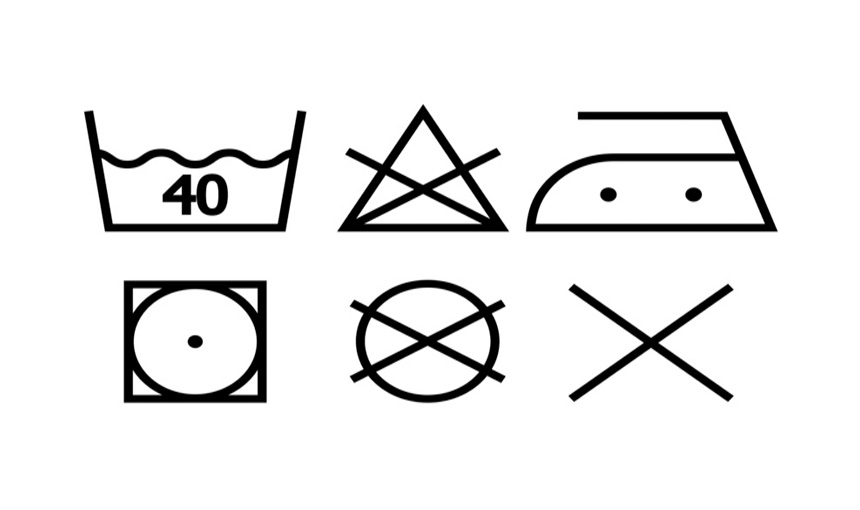
Symbols on clothing – where to find them
Instruction icons are usually found on a textile or plastic label sewn inside the garment. Most often, it is located on the inside near the collar, on a side seam, or in the waist area. Some modern pieces of clothing have this information printed on the inside of the fabric instead of labels.
We all know that labels are often cut off due to discomfort – this can cause us to lose information about proper washing or ironing, leading to damaged clothes. That is why it is good to preserve this information after cutting or tearing the label off. You can save the label or take a photo of it, especially if it is a specific fabric or type of garment.
However, experienced homemakers can usually estimate the correct care based on the fabric, color, or quality. With more frequent washing, you will easily remember these rules. Sometimes, however, minor mistakes are unavoidable, which also serve as a lesson – for example, that you really shouldn't wash a mohair sweater at 60°C if you don't want it to shrink to a child's size.
What are the most common symbols and how to read them
Here is an overview of all common symbols on clothing labels and their meanings.
Washing symbols (washtub)
- Washtub with water – machine wash allowed.
- Washtub with a number (e.g., 30, 40, 60°C) – maximum washing temperature.
- Washtub with one bar underneath – delicate wash.
- Washtub with two bars underneath – very delicate wash.
- Washtub with a hand – hand wash only.
- Washtub with a cross – do not wash.
Drying symbols (square)
- Square with a circle inside – tumble drying allowed.
- Dots inside the circle – dryer temperature settings (1 dot = low, 2 dots = medium, 3 dots = high).
- Square with a diagonal line – natural drying, on a line or flat.
- Square with a diagonal line and two bars – dry flat.
- Square with a cross – do not tumble dry.
Bleaching symbols (triangle)
- Empty triangle – bleaching allowed.
- Triangle with diagonal lines – use only non-chlorine bleach.
- Triangle with a cross – do not bleach.
Ironing symbols (iron)
- Iron with dots – specifies ironing temperature (1 dot = low, 2 dots = medium, 3 dots = high).
- Iron with a cross – do not iron.
- Iron with steam or lines – steam ironing allowed or restricted.
Dry cleaning symbols (circle)
- Empty circle – dry cleaning allowed.
- Circle with a letter (P, F, W) – type of solvent for the cleaner (P = perchlorethylene, F = delicate solvents, W = wet cleaning).
- Circle with a cross – do not dry clean.
.jpeg)
Washing machine symbols – how to use them correctly
Not only clothes but also the washing machine has its specific symbols – mainly representing various programs. Icons on the washing machine help set the correct wash or dry program that matches the information on the clothing labels. These include:
Programs by fabric type
- Cotton – intended for standard cotton clothing.
- Synthetics – intended for polyester, viscose, and mixed fabrics.
- Wool – gentle wash with lukewarm water and low spin speed.
- Delicate – suitable for silk, lace, mohair sweaters, etc.
- Quick wash – short program for lightly soiled clothes or just a few pieces.
- Heavy / Intensive – for heavily soiled or thick fabrics that need a longer wash.
Programs by purpose
- Eco / Energy-saving wash – a longer cycle at a lower temperature that saves energy.
- Handwash – a program that mimics gentle hand washing.
- Allergy – a long wash with hot water to remove allergens.
- Sports – suitable for functional materials and sportswear.
- Auto – the washer/dryer estimates the time and temperature for washing/drying itself.
Other functions and settings
- Spin – circle or spiral symbol, for removing excess water from clothes.
- Prewash – usually a small symbol next to the washtub, for heavily soiled clothes.
- Rinse – water droplet symbol, for better removal of detergents.
Tips on how to extend the life of your clothes
To make your favorite pieces last as long as possible and keep their color and shape, follow all label recommendations. Be especially careful with delicate fabrics and sensitive items, such as wool, mohair, silk, lace, as well as sweaters, bras, or coats.
Always wash according to the type and color of the clothing and never mix different pieces in one wash. Always separate laundry into white, dark, and colored. Wash delicate and sensitive items separately. Don't forget to pre-wash heavily soiled clothes.
Use the correct detergents and fabric softeners intended for a specific textile type or color. Do not use excessive amounts and follow the dosage on the packaging – less is always more. This will help you avoid detergent residue and stains on clothes.
Be careful with drying. Dry sensitive materials naturally in the air and avoid direct sunlight or radiators. When using a tumble dryer, follow the recommended temperature, otherwise the clothes may shrink.
Dry cleaning and bleaching should only be used if necessary and only if permitted. They are used for clothes that cannot be washed in water – coats, suits, evening dresses, etc. Frequent use of strong chemicals can weaken fibers and cause fading.
If you pay enough attention to all the information on the labels, follow the recommendations, and choose the appropriate method of washing, drying, or ironing, you can significantly extend the durability of your wardrobe.